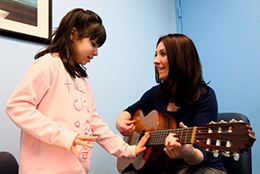
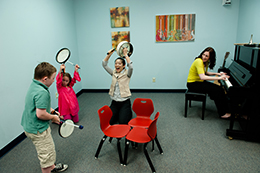
Vocal and instrumental improvisations are used to facilitate relatedness and communication between the child and therapist, while taking into consideration the child's musical and individual-differences in order to maximize back-and-forth reciprocal musical interactions.
In the context of a therapeutic relationship, as therapy proceeds, individualized themes and songs are co-developed which form the foundation for spontaneous expression and affective interactions. Depending on the needs of the child, sessions can be conducted by a team of two therapists; one of whom is primarily responsible for providing the music, while the other facilitates the child's musical participation.
Depending on the child's needs, sessions may be held 1-2 times per week. Individual sessions are allotted up to 30 minutes and group sessions 35-40 minutes. All sessions are documented and may be video-recorded so that significant responses may be noted and musical ideas transcribed for future use. In addition, it enables therapists to listen and look closely at any subtle responses not immediately evident during the session. Please note that documentation for each session can take up to 1 hour per session to complete.
Children are involved in musical activities selected to address specific clinical goals. Each musical
composition or improvisation is designed to facilitate group participation, collaboration, shared problem-solving, turn-taking, negotiating, and social integration. Close teamwork between the two therapists stimulates and supports the children's involvement in musical-play.
Various instruments, which require no prior skill or experience, are used by the child while the therapist improvises music, on the piano or guitar. The improvised music is built around the child's reactions and musical responses in order to facilitate engagement and relatedness. Every response the child offers, either intentionally or reflexively, is followed and joined by the therapist in a musical context.
The music therapist may develop musical improvisations that engage, match, support and enhance the child's playing in order to facilitate musical relatedness and communicativeness. The therapist and child, together, develop various musical themes based on the child's musical initiative. The musical themes may be brought back into following sessions to be developed in a co-creative and collaborative manner.
Within the co-created musical themes, clinical goals and treatment plans are developed by the therapist. The approach is unique in its ability to follow the child's "musical lead," while considering his/her individualdifferences, in order to facilitate robust back-and-forth interactions. In utilizing musical-play we are tapping into each child's musical sensibilities, an area that is rarely, if ever tapped into in traditional education.
The Rebecca Center for Music Therapy began in 1999 when certified music therapist John Carpente created Music for Living, an organization providing music therapy services to children with special needs and to persons afflicted with HIV/AIDS and substance abuse. In February of 2000, Music for Living developed an on-site, out-patient music therapy clinic in Melville, New York servicing special needs' children ages 3-15 with various disabilities.
In 2001, Music for Living incorporated as a non-profit organization and became "The Rebecca Center, Inc." and in 2002 received its 501(c) 3 non-profit status. In June 2002, The Rebecca Center for Music Therapy dramatically expanded its services by opening a music therapy clinic on the campus of Molloy College in Rockville Centre, New York. The Molloy College facility is the first music therapy center in Nassau County.
Since 2002 The Rebecca Center, through outreach and its on-site clinic, has served hundreds of special needs people throughout Long Island and New York.
For more information, please email us at TRCinfo@molloy.edu.